PARTNER CONTENT
By Saboor Zahir, Axioma Product Specialist, SimCorp
The hedge fund landscape has never been more competitive. In Q2 2025 alone, hedge fund asset inflows reached $24.8 billion1, marking the largest quarterly inflow since 2014. It’s no surprise emerging managers face an uphill battle to differentiate themselves in an increasingly sophisticated marketplace.
In the last decade, the industry has been transformed. Multi-manager pod-style platforms dominate asset gathering, managed account adoption has surged, and institutional investors now represent the majority of hedge fund capital. These sophisticated allocators evaluate managers through a risk lens first, seeking partners who can provide granular transparency into portfolio construction, factor exposures, and downside protection.
What does this mean for emerging managers?
This shift represents a clear pathway to competitive advantage: those who can demonstrate granular risk transparency, robust governance, and institutional-grade infrastructure, are the ones that are poised to capture more asset flows.
Key Risk Indicators for Competitive Differentiation
Allocators are looking for quantitative ways to assess the alpha and diversification benefits within their hedge fund investments. Reporting on key risk indicators can allow emerging managers to prove their worth. Below, we outline the ‘must-have’ analytics that your risk system should be able to handle. Exposure Analysis
Exposure analysis allows investors to isolate asset class level analytics. Leading managers need to be able to quantify specific positions and identify how well hedged portfolios actually are. These metrics are easy for investors to compare and aggregate across many hedge funds. Critical metrics include:
Value-at-Risk (VaR)
While exposure analysis provides asset class granularity, VaR offers the unified risk picture allocators need for portfolio construction. For example, how can managers combine equity beta exposure with a 10-year equivalent treasury exposure? The best way to do this is use a unified risk forecast that models all asset classes.
Value-At-Risk allows clients to unify risk across asset classes while simultaneously focusing on losses. The most common forecast for VaR is a 1-day 99% confidence level with a 1-year lookback using historical simulation. Factor Analysis
Factor analysis offers a different lens into risk – the capability that separates managers who understand their return sources from those operating on intuition alone. Allocators increasingly evaluate managers based on factor exposure transparency and diversification quality. Historically, factor analysis has been focused on equity strategies but new models in credit have given fund managers similar tooling in credit. Essential factor analysis includes:
Stress Testing
Ultimate diversification comes from the ability for portfolio positioning to withstand losses during extreme market events. Stress testing allows firms to find blind spots in their current positioning while also testing resiliency. Effective stress testing encompasses:
Chart 1: Interest Rate Shocks (Bps-X) vs Portfolio Returns (%-Y)
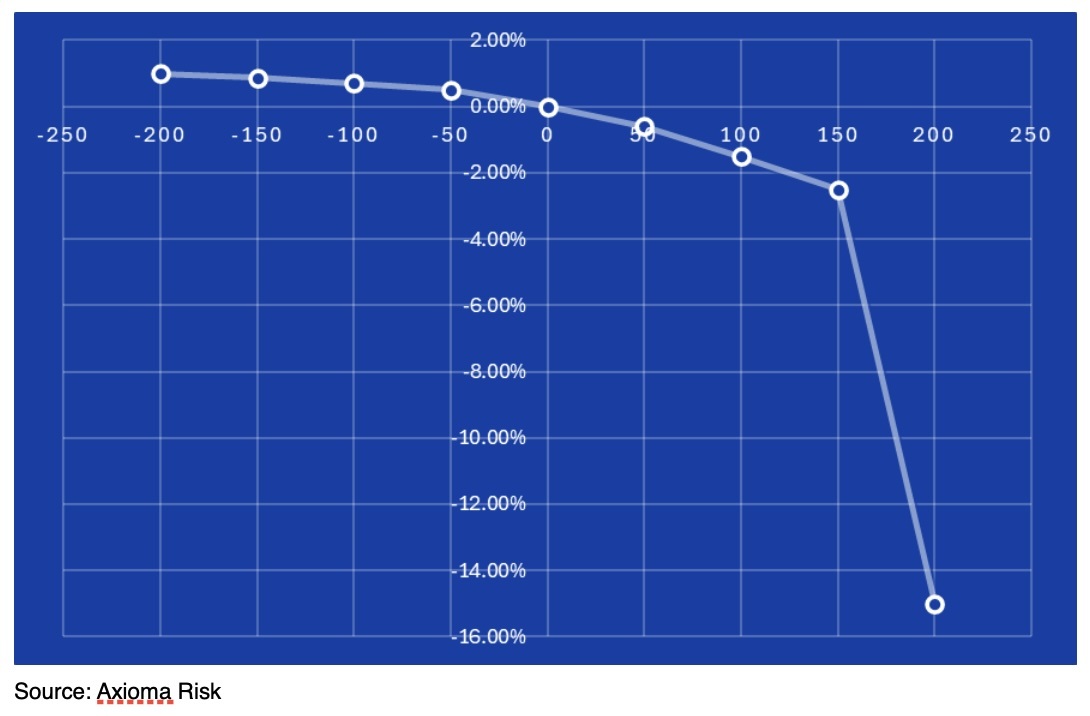
The chart above demonstrates how applying a range of stress tests enables managers to identify key inflection points in their portfolio.
Chart 2: Equity vs Volatility Stress Grid
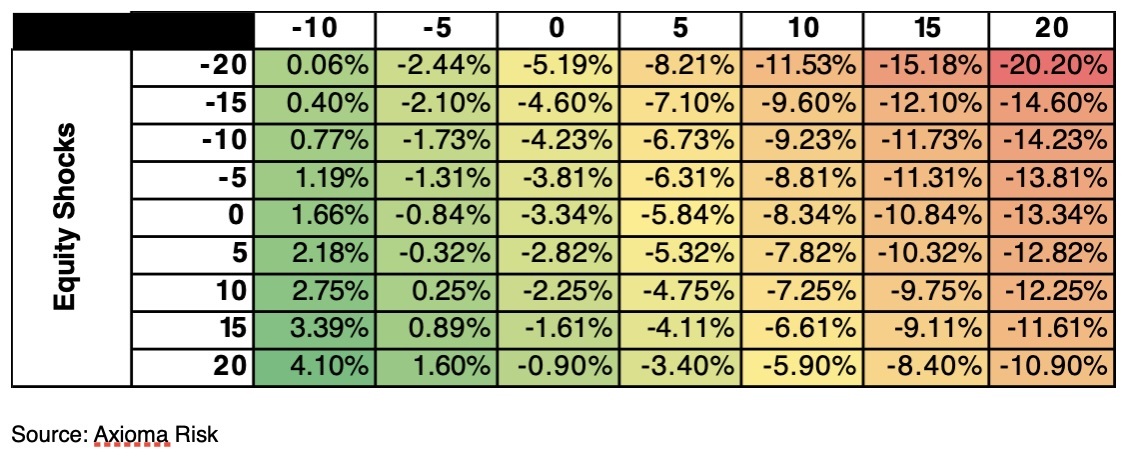
The chart above goes a step further and looks at a two-dimensional range of equity and volatility shocks for an options portfolio. You can clearly see that the portfolio is quite susceptible to poor performance when equities are down and volatility is up. Risk Technology as Competitive Advantage
Emerging managers can stand out by providing an elevated level of risk governance and transparency to their investors. Ultimately, this helps validate the diversifying qualities of hedge funds.
Delivering this level of risk transparency however, requires institutional-grade technology. Manual processes and basic spreadsheet analysis cannot provide the real-time, multi-dimensional risk insights that sophisticated allocators demand.
Leading emerging managers need to partner with established risk management platforms that offer comprehensive factor models, stress testing capabilities, and an automated reporting infrastructure. These partnerships allow smaller managers to compete with the risk management sophistication of large multi-manager platforms while maintaining operational efficiency.
To learn more, visit us at www.simcorp.com/axioma. Footnotes
 Saboor Zahir, Axioma Product Specialist, SimCorp – Saboor leads the Analytics Solutions Engineering team for SimCorp Americas, focusing on risk, performance attribution, and portfolio construction, including Axioma products. Saboor’s previous roles include leading the Axioma risk specialist teams that acted as firmwide subject matter experts in risk analytics on behalf of Axioma clients. Saboor holds a BSc in Electrical Engineering and MSc in Financial Engineering from New York University. He is also a CFA charter holder and an FRM.
Yen carry trade risks mount
Hedge funds and other leveraged investors face renewed risks from the yen carry trade as Japan moves further away from decades of…
More
Valour launches first crypto hedge fund using Neuronomics AI strategy
Valour, the digital asset investment products subsidiary of DeFi Technologies, has launched its first hedge fund as it expands beyond…
More
SocGen targets strong prime brokerage growth
Societe Generale is planning to significantly expand its prime brokerage business as part of Chief Executive Officer Slawomir Krupa's…
More
